
Review · COMMUNIST HISTORY TOURS
Communist Walking Tour of Sofia
History is written into Sofia’s streets. This three-hour walk connects the city’s communist-era buildings and monuments with stories of daily life, political change, and Bulgaria’s uneasy relationship with its past. I especially like the personal family stories guides such as Nikola, Niki, Vasko, and Martin bring to the subject, and the way the route uses major sights rather than a lecture room. The main drawback is simple: you will walk a fair distance, and the 4:00 pm start can leave the final monuments in darkness during winter.
At $21.77 per person, this is strong value for a focused history tour led in English. I also like the balanced approach. Guides explain communist ideology, but they also discuss its costs, contradictions, and effects on ordinary people instead of turning the afternoon into a one-sided political speech. Bring comfortable shoes, check the weather, and follow the meeting-point directions carefully, since the tour begins at the Sofia City Court, not at the National Palace of Culture.
In This Review
- Key points to know before you go
- Why Sofia’s communist past deserves an afternoon
- Starting at the Sofia City Court
- Saint Petka and religion under communism
- The Presidency and the arrival of the Soviet Army
- The Largo, the Red Star, and the former party headquarters
- City Garden and the story of the Mausoleum
- The Soviet Army Monument and Sofia’s public argument
- NDK, Sofia’s largest communist landmark
- Finishing beside a piece of the Berlin Wall
- Walking distance, weather, and group comfort
- What the $21.77 price gets you
- Who should book this Sofia walk?
- Should you book the Communist Walking Tour of Sofia?
- FAQ
- Where does the Communist Walking Tour of Sofia begin?
- Where does the tour end?
- What time does the tour start?
- How long does the walking tour last?
- What language is the tour offered in?
- What is included in the price?
- How many people can join the tour?
- Can I cancel for a full refund?
Key points to know before you go
- Personal stories make the politics easier to understand: Guides use family experiences and everyday examples to explain life during Bulgaria’s communist period.
- The route links Sofia’s biggest symbols: You see the Palace of Justice, the Largo, the former Communist Party headquarters, the Soviet Army Monument, NDK, and a piece of the Berlin Wall.
- Three hours means a real city walk: There are several stops and pauses, but this is not a short stroll around one square.
- The Soviet Army Monument is a major talking point: Its graffiti, public controversy, and connection to early opposition give the tour a strong visual center.
- The 4:00 pm schedule matters: Summer light should suit the route well, but winter darkness can make the final section harder to see.
- Small groups help the discussion: The maximum group size is 25, and guides regularly answer questions throughout the walk.
Why Sofia’s communist past deserves an afternoon
Sofia is full of ancient churches, Roman remains, grand government buildings, and modern cafés. It is easy to pass through the center without noticing how much of the city was shaped by the communist period. This tour gives you a way to read those streets differently.
The focus is not only on dates and leaders. You hear about ideology, the arrival of the Soviet Army, the role of religion, the removal of communist symbols, and the ways ordinary families lived during the Cold War. That mix is what gives the experience its value.
I like historical tours best when the buildings do part of the explaining. Here, the architecture, statues, empty spaces, and surviving symbols provide the framework. A guide then adds the human detail that a plaque cannot provide.
Several guides have been praised for making difficult material clear and lively. Nikola and Niki are noted for strong storytelling and personal examples. Vasko is praised for using pictures, allowing breaks, and handling questions. Martin is known for connecting architecture, culture, and political change. Stefan, Yoan, and Vasil have also been singled out for friendly, engaging presentations.
The exact guide can shape the afternoon, but the repeated strengths are clear: strong preparation, humor, personal connection, and a willingness to explain the pros and cons of the period.
More Communist History Tours in Sofia
- Sofia: Communist Walking Tour
★ 4.9 · 1,106 reviews - Sofia: Museum of Socialist Art and Buzludzha Monument Tour
★ 4.9 · 86 reviews - From Sofia: The Rose Valley & Buzludzha Monument Day Tour
★ 4.8 · 77 reviews
Starting at the Sofia City Court
The tour begins at the Sofia City Court, also called the Palace of Justice, at bul. Vitosha 2 in the old city center. The first two stops are close together, with about ten minutes allocated at the court and at the 365 Association Sofia Tours meeting point.
This opening is practical rather than flashy. You get oriented, meet the guide, and begin with a building that helps place communist Sofia within the city’s wider political story. Since the meeting point is central and near public transportation, it is easy to reach before the 4:00 pm start.
I would arrive early. One person lost part of the tour after following directions that led to the end point instead of the start. The beginning and end are in different parts of central Sofia, so confirm that you are heading to the Sofia City Court, not NDK.
The tour is offered in English and includes a local professional guide. It is capped at 25 people, which is a reasonable size for a walking group, though the experience will still feel more personal with a smaller turnout.
Saint Petka and religion under communism
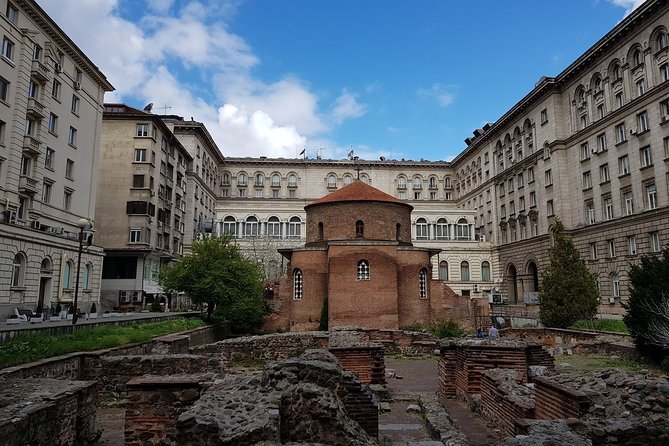
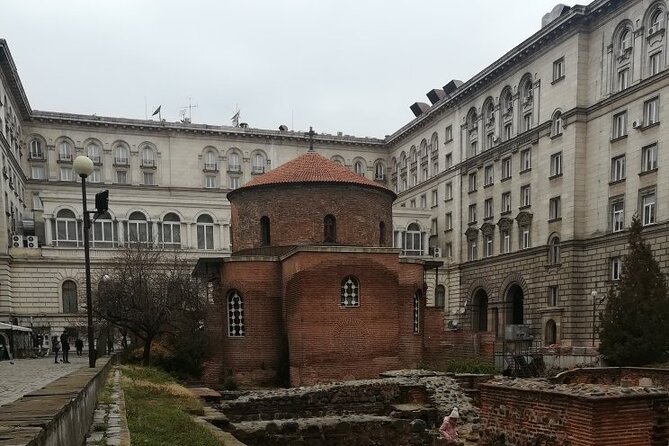
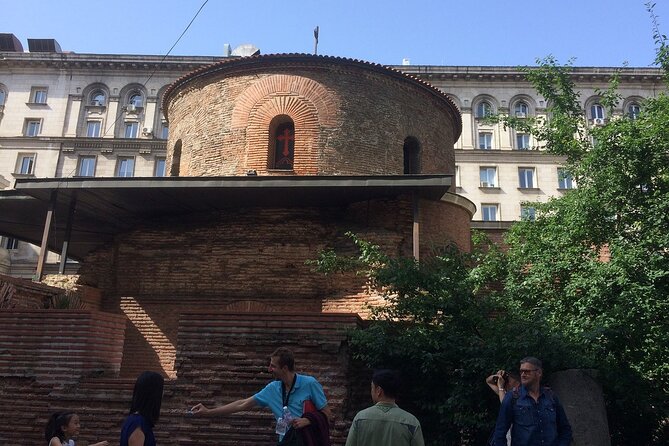
The next stop is the Ancient Orthodox Church of Saint Parascheva, known as the old Saint Petka. It is presented as a tucked-away church and as a way to discuss religion during the communist period.
This stop adds needed balance. A tour about communist landmarks could easily focus only on party buildings, official monuments, and state power. Saint Petka shifts the subject toward belief, public life, and the place of religious practice under an officially communist system.
The stop is brief, around ten minutes, so you should not expect a long church visit. Its value is the context supplied by the guide. Look closely, listen carefully, and ask questions if you want to understand how religion fit into the period being discussed.
This is also a useful reminder that Sofia is not a city built in one historical layer. Ancient and Orthodox sites sit beside modern political symbols, often within a short walk of one another.
The Presidency and the arrival of the Soviet Army
At the Presidency Building, the guide explains the arrival of the Soviet Army in Bulgaria. This is one of the tour’s key political turning points.
The stop helps you understand that communism did not appear as an isolated local event. Bulgaria’s postwar direction was tied to the wider Soviet sphere, and the guide uses the central government buildings to explain that shift.
This part is likely to appeal most to anyone who wants political background rather than only visual sightseeing. Guides are praised for explaining complex subjects in plain language and for answering questions without rushing the group.
The best moments come when the guide connects national events to ordinary life. Several guides have used personal family experiences to show how large political changes reached into homes, work, education, and daily decisions. That approach makes the subject feel close rather than abstract.
More Walking Tours in Sofia
- Sofia: City Monuments Guided Walking Tour with Audio Guide
★ 4.5 · 825 reviews - Sofia Highlights 2 Hour Sightseeing Walking Tour
★ 5.0 · 442 reviews - Guided Walking Tour of Sofia
★ 5.0 · 143 reviews - Private city walking tour of Sofia
★ 5.0 · 141 reviews
The Largo, the Red Star, and the former party headquarters
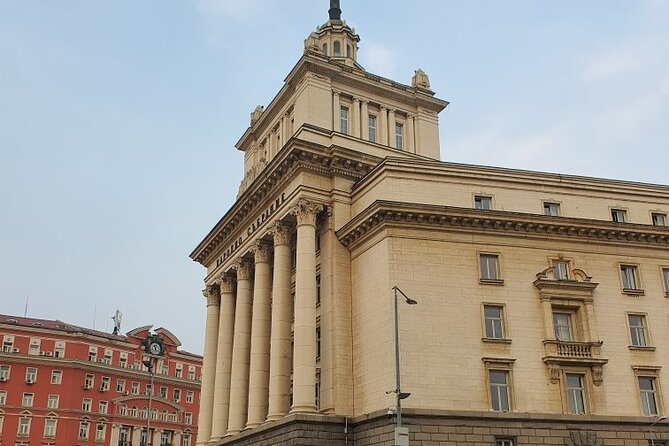
The route continues to the Largo, the grand central complex that includes the former headquarters of the Bulgarian Communist Party. The guide discusses the Red Star and the former statue of Lenin, along with the symbolism attached to this part of Sofia.
This is one of the strongest sections for understanding how a political system presented itself in public. Large buildings and official symbols were not accidental decoration. They expressed authority, order, and the power of the state.
At the same time, you should expect some of the story to involve what has disappeared. Communist symbols were removed or altered after the period ended, and parts of the old visual language are no longer present. One guide uses images to show what the area looked like before changes erased or reshaped some of its symbols.
That is a strength of the tour. You are not limited to what remains in front of you. The guide helps you picture missing statues, signs, and emblems, then explains why they were taken away.
City Garden and the story of the Mausoleum
In the City Garden, the focus turns to the Mausoleum. This stop is another example of how absence can tell a story.
The Mausoleum once represented the political order, yet it is no longer there. The guide uses its former presence to explain the early communist days and the changing meaning of Sofia’s public spaces.
You may find this section especially useful if you are interested in how cities deal with unwanted symbols. Removing a monument does not remove the events connected with it. The empty space becomes part of the history.
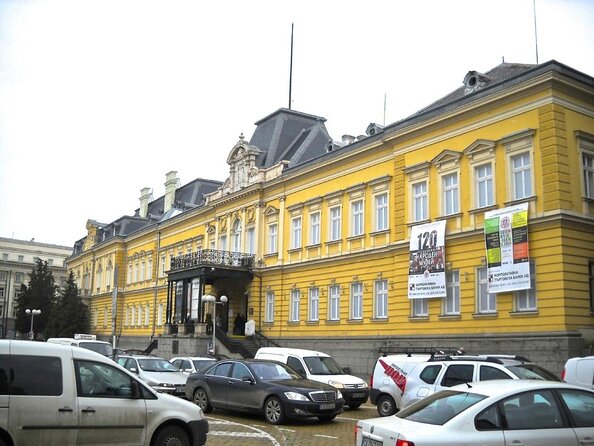
The route also passes the former Royal Palace and discusses the building during the early communist period. That creates an interesting contrast between monarchy and communist rule. You see how the same city center carried different political messages over time.
The stop is short, but the wider lesson is important: Sofia’s central buildings were repeatedly given new meanings. The tour helps you notice those changes instead of treating the city center as a collection of unrelated sights.
The Soviet Army Monument and Sofia’s public argument
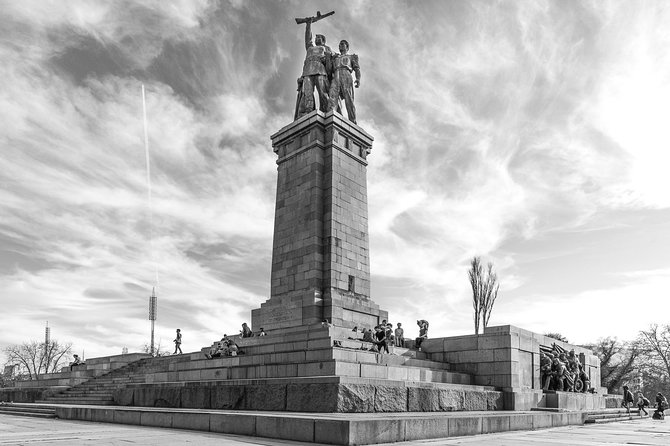
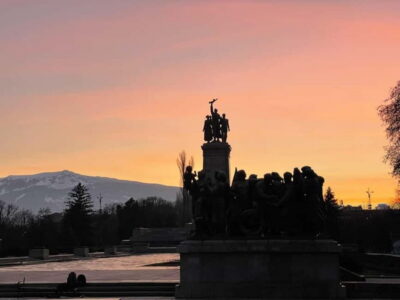
The Soviet Army Monument receives about 15 minutes and is probably the tour’s most visually arresting stop. It is one of Sofia’s most controversial monuments, and its graffiti has made it a canvas for modern political expression.
The guide explains the monument’s connection to the Soviet Army, as well as early uprisings against the communist regime. This is where the past and present meet most clearly. The monument is not just a piece of stone or bronze. It remains part of a live argument about memory, identity, and public space.
I would allow extra attention here. Look at the monument itself, notice the surrounding park, and listen for the explanation of how graffiti changed its meaning. The stop gives you a better sense of why communist monuments can be difficult to classify as either heritage or propaganda.
Because the monument is outdoors, weather matters. One group completed the tour in temperatures as low as minus 6 degrees, while another walked through heavy rain and a storm. Their guides adjusted the pace and allowed a short café break during bad weather, but you should still dress for a genuine outdoor walk.
NDK, Sofia’s largest communist landmark
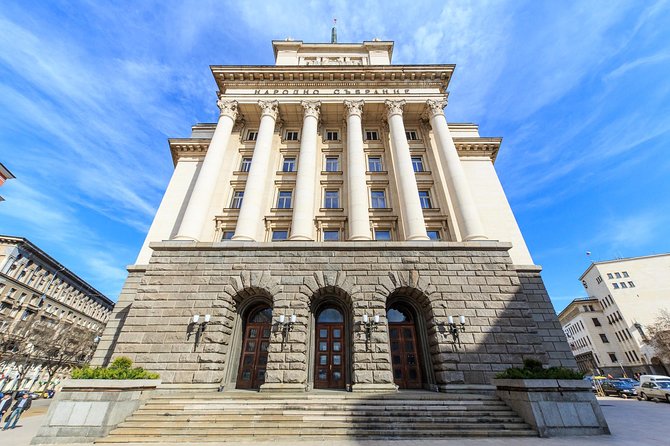
The National Palace of Culture, usually called NDK, is the biggest communist landmark on the route. It also remains a major cultural hub, so this stop connects the political past with the building’s continuing public role.
The scale of NDK helps explain how communist states used architecture to project confidence and modernity. This is not a small memorial or a hidden corner. It is a major urban statement, and the guide places it within the wider story of Bulgaria’s communist years.
The stop lasts about ten minutes. You will not receive a full architectural tour, but you will get a useful explanation of why NDK matters and how it fits the city.
The route ends near NDK, next to a piece of the Berlin Wall on the left side of the Palace of Culture park. That final location gives the tour a clear closing image. You move from the formation of the communist system to the moment when its division of Europe began to collapse.
Finishing beside a piece of the Berlin Wall
The Berlin Wall fragment is the final stop and lasts about 15 minutes. The guide uses it to tell the story of how the communist period ended.
This ending works because it widens the view beyond Bulgaria. The tour begins with local political change and ends with a symbol understood across Europe. It also gives you a natural place to reflect on the difference between official power and the forces that eventually brought the system down.
The weak point is timing. The tour starts at 4:00 pm, and in winter the last hour may take place after dark. Two people specifically found that the late timing made it hard to see the monuments near the end. If you are visiting in winter, ask yourself how much you care about seeing the buildings clearly. The stories can still be useful, but the visual side of the walk will be reduced.
Walking distance, weather, and group comfort
This is a proper three-hour walk through central Sofia. It is not described as suitable for people with limited mobility, and one account specifically warns that the route covers a fair amount of ground. Most people can participate, but comfortable shoes are essential.
The good news is that the route includes regular talking stops and breaks. Vasko was praised for choosing an easy path and allowing pauses, and another guide stopped at a nearby bar or café when a storm arrived.
The tour is suitable for families, provided children are accompanied by an adult. One guide was especially good at keeping children involved and answering their questions.
Service animals are allowed, and the route is near public transportation. The outdoor format means you should plan for cold, rain, or early darkness rather than assuming Sofia’s weather will cooperate.
What the $21.77 price gets you
At $21.77, you are paying for roughly three hours with a local English-speaking guide, not for entry tickets. The listed stops are free, so the main value lies in the route design, explanations, photographs, and personal stories.
I consider that a fair price, particularly if you are new to Sofia or know little about Bulgaria’s twentieth-century history. A standard city walk may show you the main sights, but this tour gives those sights a clear subject and connects them into one story.
The value is strongest when your guide uses the city as evidence. The former headquarters, the missing Mausoleum, the disputed Soviet Army Monument, NDK, and the Berlin Wall fragment each mean more when you understand what they represented.
The tour has a 4.9 rating from 690 reviews, with 98 percent recommending it. Those numbers do not guarantee a perfect afternoon, but they match the consistent praise for the guides’ storytelling, balance, patience, and command of the subject.
Who should book this Sofia walk?
I would choose this tour if you want recent political and social history, especially if you prefer real buildings and personal accounts to a museum-only visit. It is also a smart choice near the start of a Sofia stay because it gives you context for the city and country.
You will get the most from it if you enjoy asking questions. Guides such as Niki, Nikola, Vasko, Martin, Stefan, Yoan, and Vasil have been praised for welcoming questions and explaining both the benefits claimed by the communist system and the harm it caused.
I would hesitate if you dislike walking, outdoor tours, or political history. I would also think twice about a winter booking at 4:00 pm if seeing every monument clearly is important to you.
Free cancellation is available up to 24 hours before the start time. Children must have an adult with them, and the maximum group size is 25.
Should you book the Communist Walking Tour of Sofia?
Yes, if you want more than a quick look at Sofia’s grand buildings. The best reason to book is the combination of public landmarks and private memory. Guides explain ideology and political change, then bring the subject down to the level of family life and everyday choices.
Book it early in your stay for useful city context, wear shoes suited to three hours of walking, and check the meeting point twice. If you visit in winter, consider the limited daylight. With those points in mind, this is a thoughtful, fairly priced introduction to Bulgaria’s communist past and to the difficult work of remembering it.
FAQ
Where does the Communist Walking Tour of Sofia begin?
It begins at the Sofia City Court, also called the Palace of Justice, at bul. Vitosha 2 in Sofia’s old city center.
Where does the tour end?
The tour ends at the National Palace of Culture, next to a piece of the Berlin Wall on the left side of the Palace of Culture park.
What time does the tour start?
The tour starts at 4:00 pm.
How long does the walking tour last?
It lasts approximately three hours.
What language is the tour offered in?
The tour is offered in English.
What is included in the price?
A local professional guide is included. Admission tickets are free at the listed stops.
How many people can join the tour?
The maximum group size is 25 people.
Can I cancel for a full refund?
Yes. You can cancel at least 24 hours before the experience start time for a full refund. Changes or cancellations made less than 24 hours before the start time are not accepted for a refund.
Recently added around Sofia
- Veliko Tarnovo & Arbanasi Full day tour★ 5.0 · 5 reviews
- Private Winter Day Trip to the Rila Mountain★ 4.5 · 3 reviews
- Sofia Hidden Gems: Small-Group Walking Tour with Tram Ride★ 5.0 · 7 reviews
- Private transfer from Sofia to Plovdiv or vice versa★ 5.0 · 8 reviews
- Zemen Monastery, Boyana Church and National History Museum Tour★ 5.0 · 2 reviews
- Catacomb Tour in Sofia guided by a Local★ 4.5 · 3 reviews
- Tour to Koprivshtitsa and the Buzludzha monument incl the Seuthes Thracian Tomb★ 3.5 · 3 reviews
- From Sofia: The gorges of Trun and Dragovski stone trail★ 5.0 · 6 reviews
Communist History Tours, compared.
Museum of Socialist Art and Buzludzha Monument Tour
Read our review →
Sofia Communist History 2-Hour Tour in a Classic Trabant
Read our review →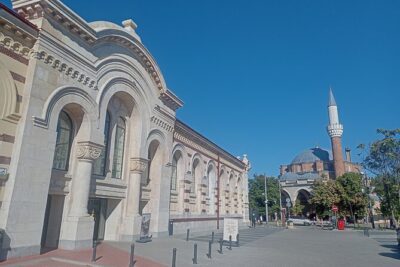
Sofia Food & Tasting Tour with Communist-Era Tram Ride
Read our review →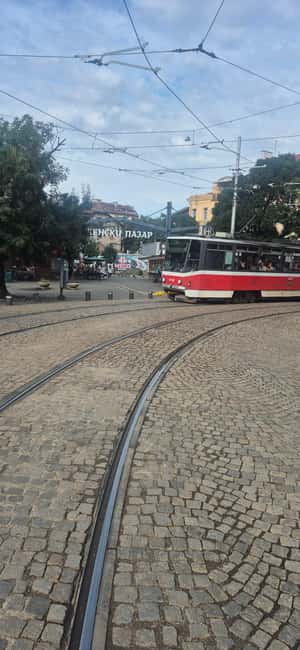
5-Stop Food & Culture Tour by Communist-Era Tram
Read our review →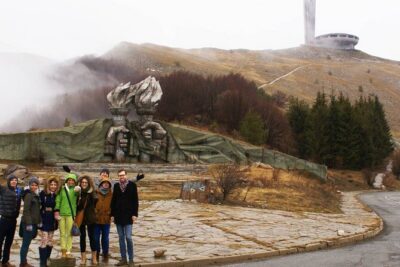
Buzludzha Monument and The Rose Valley Day Tour From Sofia 13 hrs
Read our review →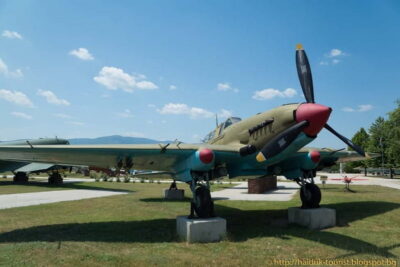
Buzludzha Monument & Museum of Aviation Day Trip
Read our review →Browse the lists this tour appears in