
Review · WALKING TOURS
Sofia Hidden Gems: Small-Group Walking Tour with Tram Ride
Sofia rewards curious walkers. This small-group tour brings together Roman ruins, Orthodox churches, grand civic buildings, and everyday markets in about two to three hours. I like the mix of famous sights and less obvious stops, especially the chance to enter the National Library and Sofia University rather than simply admire their facades.
I also like the human scale. The group is limited to 10 people, and the $45.66 price includes an English-speaking guide plus a city transport card and short tram or metro ride. The main drawback is pace: with many stops, most visits last only five to 15 minutes, so you get a useful introduction rather than long museum visits or quiet time inside each building.
Peter, the guide, receives especially warm praise for his patience, energy, and willingness to answer questions. He has also added bonus locations, waited while guests bought souvenirs, and even offered water. That personal attention can make a major difference on a walking tour.
In This Review
- Key points to know before booking
- From Saint Sofia Church to Alexander Nevsky Cathedral
- Art, books, and Sofia’s first university
- Opera, theatre, and the city’s grand public buildings
- The Largo and the red-brick Rotunda
- Roman Serdica beneath modern Sofia
- Mineral baths, synagogue, mosque, and the Western Gate
- Women’s Market and Banya Bashi Mosque
- The tram ride and the value of the $45.66 price
- Meeting point, timing, and practical advice
- Who should book this Sofia walk?
- Should you book it?
- FAQ
- How long does the Sofia Hidden Gems walking tour last?
- What language is the tour offered in?
- How many people can join the tour?
- Is transportation included?
- Where does the tour start?
- Where does the tour end?
- Are admission tickets included?
- Can I cancel for a full refund?
Key points to know before booking
- A compact tour with a wide historical range: You move from fourth-century churches and Roman Serdica to Ottoman, royal, socialist, and modern Sofia.
- The group never exceeds 10 people: This is small enough for questions and easier movement through busy central streets.
- The tram or metro ride is included: You receive a city transport card, and travel time between sights is part of the tour.
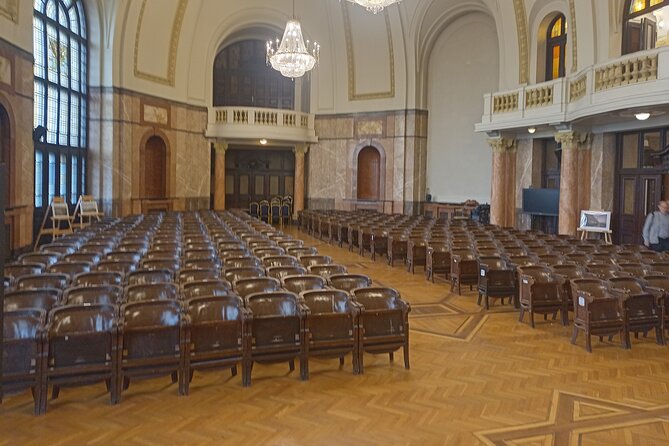
- Two interior visits add real value: The route includes the Bulgarian National Library and Sofia University, not just outside views.
- No separate admission charges are listed: The churches, library, university, ruins, and other stops are covered without an extra ticket.
- The finish is practical: You end at Sofia Central Market Hall, close to a bus station and public transport.
From Saint Sofia Church to Alexander Nevsky Cathedral
The tour begins at Saint Sofia Church on Paris Street, a sensible starting point for understanding the city’s name. The present church dates to the fourth century, and an earlier building hosted the Council of Serdica, probably in 343, with 316 bishops in attendance. In the 14th century, the church gave Sofia its current name. Before then, the city was known as Serdika.
You get about 10 minutes here, with admission listed as free. That is enough to hear the basic story and look at the building, but not enough for a slow inspection of every detail. If Saint Sofia matters especially to you, consider returning later on your own.
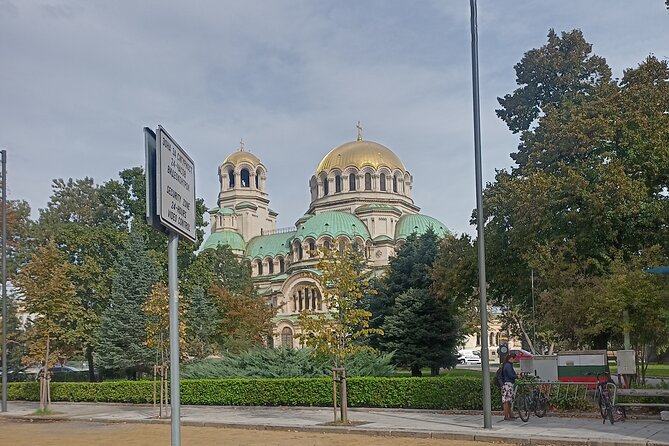
From there, you visit St. Alexander Nevsky Cathedral, Sofia’s best-known Orthodox church. Its Neo-Byzantine design and huge scale make it an important visual stop, even on a short schedule. It is one of the 50 largest Christian church buildings in the world by volume.
The cathedral visit is also limited to about 10 minutes. I would treat it as a first look, not a full church visit. The route works best if you want a guide to explain why the building matters, then plan extra independent time if you want to study the interior.
More Walking Tours in Sofia
- Sofia: Communist Walking Tour
★ 4.9 · 1,106 reviews - Sofia: City Monuments Guided Walking Tour with Audio Guide
★ 4.5 · 825 reviews - Communist Walking Tour of Sofia
★ 5.0 · 690 reviews
Art, books, and Sofia’s first university
The route continues through the cultural center of Sofia, with a stop at Kvadrat 500, the newest and largest building of the National Gallery. It opened in 2015 and displays about 1,700 works from a collection of more than 42,000 pieces. The galleries cover Bulgarian art from the mid-19th century onward, European art from the 15th to 19th centuries, and works from Asia, Africa, and America.
The information provided does not specify a timed interior visit here, so you should not expect a full museum tour during this experience. The value is in seeing how Sofia’s museum district fits into the larger city story. If you are serious about art, save Kvadrat 500 for a separate visit.
One of the more unusual parts of the walk is the Bulgarian National Library, also called the St. St. Cyril and Methodius National Library. Its collection contains nearly 8.5 million documents, and it receives about 70,000 new publications each year. The tour goes inside for around 10 minutes.
That short interior visit is a strong feature. Many city walks stop at a library only for a photograph, while this one lets you enter Bulgaria’s largest book collection. You will not have time for a long look around, but you get a better sense of the institution’s place in Bulgarian cultural life.
Next comes Sofia University St. Kliment Ohridski, Bulgaria’s first higher education institution. Its story reaches back to centuries of teaching traditions, with public educational activity dating to the second half of the ninth century. The route includes an interior visit of about 10 minutes.
I like this pairing of library and university. Together, they show Sofia as a center of learning, not only a capital filled with monuments. The short timing remains the main limitation, so listen closely to the guide and ask your questions while you are inside.
Opera, theatre, and the city’s grand public buildings
The walk then passes a neo-Renaissance building designed by Constantin Yovanovic, who studied in Vienna and Switzerland and also designed the Serbian Assembly. It was built from 1884 to 1886. The stop adds architectural context to the city’s late-19th-century growth, when Sofia was developing new public institutions after Bulgaria’s Liberation in 1878.
You also hear about the beginning of Bulgarian opera. In 1890, Dragomir Kazakov, Ivan Slavkov, and Angel Bukoreshtliev organized the country’s first opera troupe as part of the Sofia Drama and Opera Troupe. Its early performances included 12 complete operas and excerpts from 11 more, with Bulgarian, Czech, and Italian performers.
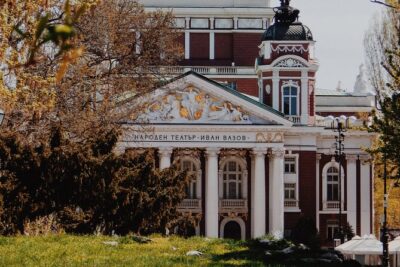
The National Theatre follows. Its building was completed in 1906, with the opening ceremony held on January 3, 1907. Architects Ferdinand Fellner and Hermann Helmer designed it in the Art Nouveau style, and Rudolf Fuchs of Vienna painted the auditorium’s ceiling and walls. The auditorium seats 848 people.
These stops are best for people who enjoy city design and cultural history. You will not attend a performance, and the schedule does not promise an extended interior visit. Still, the buildings help connect Sofia’s political development with its music, theatre, and public life.
The Largo and the red-brick Rotunda
The Largo is one of Sofia’s clearest examples of 20th-century urban planning. This architectural group of three Socialist Classicism buildings was designed in the 1950s as the city’s new representative center. Its formal style contrasts sharply with the older churches and Roman remains nearby.
That contrast is one reason this route works well. Sofia is not a city that presents its history in neat chronological order. Roman ruins, medieval religious buildings, Ottoman traces, modern galleries, and socialist architecture appear within a short walk of one another.
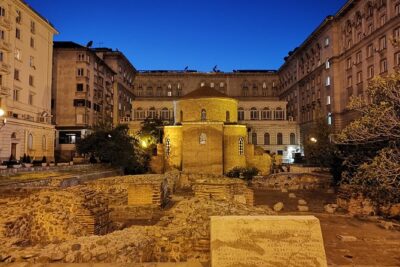
At the Rotunda Church of St. George, you reach one of the city’s oldest surviving buildings. The red-brick rotunda began as Roman baths in the early fourth century and later became an early Christian church within the walls of Serdica. It is considered the oldest building in modern Sofia and remains part of the Bulgarian Orthodox Church.
The planned stop lasts about five minutes, with free admission listed. That is brief, but the building is compact and visually distinctive. You will want to pause for a close look at the brickwork and the way the rotunda sits among later structures.
Elsewhere in Bulgaria, a very different sort of day:
- From Sofia: Rila Monastery & Boyana Church Day Tour
★ 4.7 · 5,107 reviews - From Sofia: Must-See Rila Monastery & Boyana Church Day Tour
★ 4.6 · 3,322 reviews - From Sofia: Guided Day Tour of Plovdiv’s Must-See Sights
★ 4.6 · 1,688 reviews - From Sofia: 7 Rila Lakes and Rila Monastery Extended Trip
★ 4.7 · 1,189 reviews
Roman Serdica beneath modern Sofia
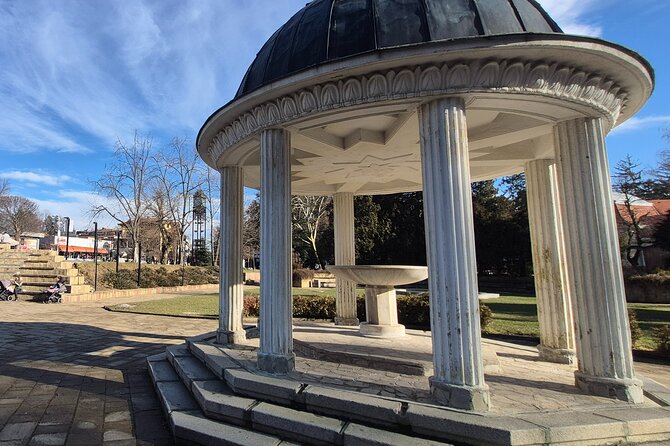
The Ancient Serdica Archaeological Complex gives you the clearest look at Sofia’s Roman past. Located below Nezavisimost Square, it includes the remains of the decumanus maximus, one of the main streets linking the eastern and western gates of the ancient town.
You can also see a large residential building that occupied an entire city block, along with small shops where people bought food and other goods. A lapidarium is located nearby. The planned visit lasts about 15 minutes.
This is one of the most useful stops for understanding the city’s layers. You are not simply looking at isolated stones. The street, housing block, shops, and defensive gates help you picture Serdica as a working Roman town.
Still, archaeological sites need time and imagination. The guide’s explanation matters here because the remains can be difficult to read at a glance. If you prefer long museum visits with detailed signs, this quick stop may feel too short. If you want a clear introduction to Roman Sofia, it earns its place.
Mineral baths, synagogue, mosque, and the Western Gate
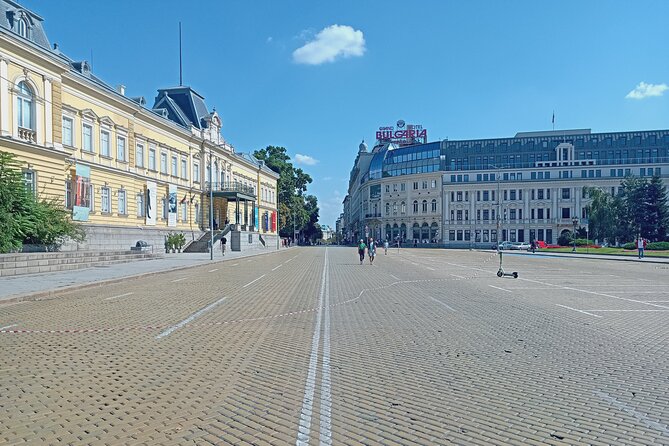
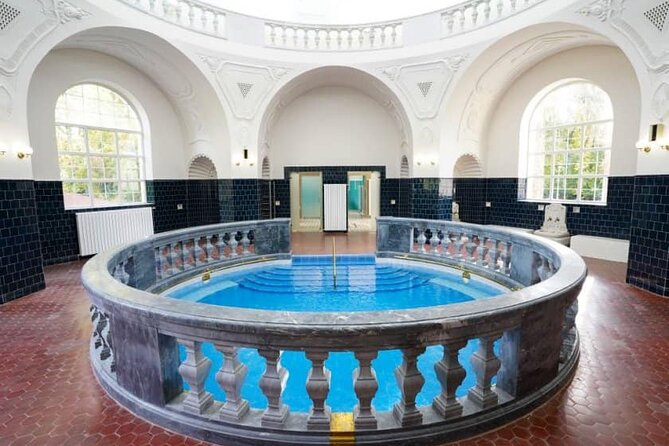
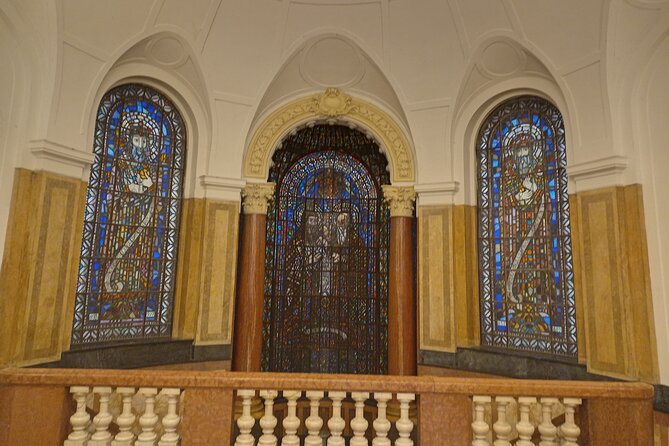
The Central Mineral Baths are among Sofia’s most attractive public buildings. Designed in 1904 and 1905 by Petko Momchilov and Friedrich Grünanger, the building uses the Vienna Secession style while adding Bulgarian, Byzantine, and Eastern Orthodox decorative elements. The project was approved in 1906 after earlier designs by Austrian and French architects were rejected.
The stop lasts about 10 minutes. Look for the combination of European architectural ideas and local ornament. The building also reflects Sofia’s hot mineral springs, which have long influenced the city’s public life.
The route then brings you near the Central Sofia Synagogue. Its early-20th-century construction was organized by Sofia’s Jewish community, led by Rabbi Dr. Ehrenpreis and community president Ezra Sol. Viennese architect Friedrich Grünanger completed the project in four years.
One particularly unusual detail is that tombstones from an old Jewish cemetery were used in the synagogue’s base. Inside, you can see the names of the 10 top contributors on the wall to the left after entering. The building cost 437,000 golden leva at the time. The synagogue was built on the earlier site of a synagogue known in Hebrew as Ahava ve Chesed, meaning Love and Goodness.
At the Western Gate of Serdica, the surviving fortress wall includes a pentagonal tower near the gate and a triangular tower close by. The gate lies between St. Joseph Catholic Cathedral, Todor Alexandrov Boulevard, and the Monument Symbol of Sofia.
This is a short five-minute stop, but it helps complete the Roman picture begun at the archaeological complex. You see how the city was defended, then move toward the market district where modern daily life takes over.
Women’s Market and Banya Bashi Mosque
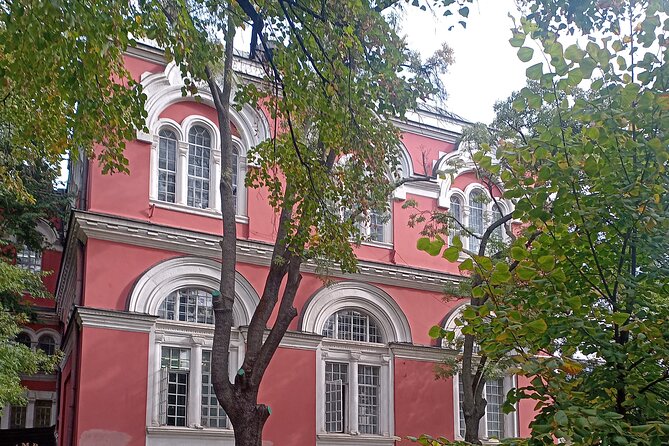
Zhenski Pazar, or Women’s Market, is Sofia’s oldest market. It was established more than 140 years ago and remains one of the city’s important trading centers. The tour allows about 10 minutes here.
That is enough to get a taste of the place, but not enough for a serious shopping trip. You might want to return after the tour if you wish to browse for food or souvenirs at a slower pace. The market is valuable because it shifts the focus from monumental Sofia to ordinary commerce.
The final sight is Banya Bashi Mosque, near the city’s hot mineral springs. Its name means many baths, and it was built in 1576 during the Ottoman period by Mimar Sinan, the famous Ottoman architect also associated with the Selimiye Mosque in Edirne and the Suleymaniye Mosque in Istanbul.
The mosque adds an important Ottoman chapter to the route. Along with the Orthodox churches, Jewish synagogue, Catholic reference near the Western Gate, Roman remains, and socialist buildings, it shows the range of traditions that shaped central Sofia.
The tram ride and the value of the $45.66 price
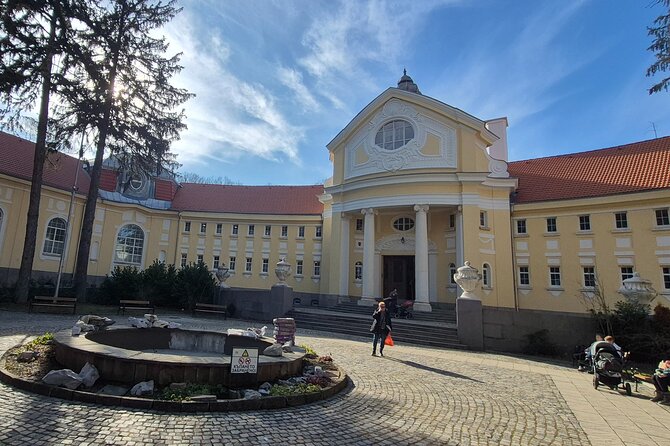
The tour includes a city transport card and a short tram or metro ride. This is more than a small convenience. It breaks up the walking, gives you a glimpse of how Sofia moves today, and helps connect sights that would otherwise make the route feel rushed.
Travel time between places is included in the two to three-hour duration. The actual sightseeing time at the named stops adds up quickly, so the transport leg helps keep the day manageable. Wear comfortable shoes, but do not treat this as an all-day hike.
At $45.66 per person, the price is fair if you value explanation, route planning, and access to the library and university. You are also paying for a small group, an English guide, and transport. Since no separate admission fees are listed for the main stops, you will not need to build in a long list of ticket costs.
The price is less appealing if you want extended time inside museums or churches. In that case, a self-guided walk with separate museum tickets might suit you better. For a first visit to Sofia, though, the range of sights makes the cost reasonable.
Meeting point, timing, and practical advice
The tour starts at Saint Sofia Church, Old City Center, on ul. Paris 2. It ends at Sofia Central Market Hall, on 25 Knyaginya Maria Luiza Boulevard, level minus one. The endpoint is close to a bus station, so returning from there is straightforward.
Confirmation is provided at booking, and the tour is offered in English. Most people can participate, and the route is near public transportation. The group maximum is 10 people, which is important when you are moving through central streets and entering public buildings.
Bring sunscreen, as the practical instructions specifically call it out. You should also allow enough time to reach the starting point and avoid arriving at the last minute. The cancellation policy allows a full refund if you cancel at least 24 hours before the start time. Changes or cancellations inside that window are not accepted for a refund.
The strongest reason to choose this experience is the guide. Peter is described as patient, energetic, and ready to answer questions about Bulgaria on many subjects. His habit of adding bonus locations, helping with souvenirs, and offering water suggests a friendly style rather than a rigid speech delivered at every corner.
Who should book this Sofia walk?
I would recommend it to a first-time visitor who wants a fast, organized introduction to central Sofia. It also suits anyone who likes connecting architecture, religion, politics, archaeology, and daily life in one route.
It is a good choice for solo visitors and couples who prefer a small group. The 10-person limit gives you a better chance to hear Peter and ask questions than you would on a large coach tour.
You should think twice if you dislike short stops or want to linger inside the National Gallery, Alexander Nevsky Cathedral, the synagogue, or the Roman complex. This tour gives you a map of Sofia’s past and present, then leaves you with several places worth revisiting.
Should you book it?
Book this tour if you want breadth, personal guiding, and a small group more than long visits at individual sights. The route covers an impressive range, from ancient Serdica to the Women’s Market, and Peter’s patient, helpful approach appears to be a major part of its appeal.
Skip it only if your priority is a slow museum day or a narrowly focused architecture tour. For most first visits, the combination of walking, public transport, free-entry sights, and practical city orientation makes $45.66 a sensible introduction to Sofia.
FAQ
How long does the Sofia Hidden Gems walking tour last?
The tour lasts approximately two to three hours, including travel time from place to place.
What language is the tour offered in?
The tour is offered in English.
How many people can join the tour?
The maximum group size is 10 travelers.
Is transportation included?
Yes. The tour includes a city transport card and a short tram or metro ride.
Where does the tour start?
It starts at Saint Sofia Church, Old City Center, ul. Paris 2, 1000 Sofia, Bulgaria.
Where does the tour end?
It ends at Sofia Central Market Hall, Central Sofia Market Hall, Knyaginya Maria Luiza Boulevard 25, level minus one, 1000 Sofia, Bulgaria.
Are admission tickets included?
The listed stops show free admission, and no separate entrance charge is included in the tour price.
Can I cancel for a full refund?
Yes. You can cancel at least 24 hours before the experience start time for a full refund. Cancellations or changes made less than 24 hours before the start time are not accepted for a refund.
Recently added around Sofia
- Veliko Tarnovo & Arbanasi Full day tour★ 5.0 · 5 reviews
- Private Winter Day Trip to the Rila Mountain★ 4.5 · 3 reviews
- Zemen Monastery, Boyana Church and National History Museum Tour★ 5.0 · 2 reviews
- Private transfer from Sofia to Plovdiv or vice versa★ 5.0 · 8 reviews
- Catacomb Tour in Sofia guided by a Local★ 4.5 · 3 reviews
- Tour to Koprivshtitsa and the Buzludzha monument incl the Seuthes Thracian Tomb★ 3.5 · 3 reviews
- From Sofia: The gorges of Trun and Dragovski stone trail★ 5.0 · 6 reviews
- Sofia Under Communism: Self-Guided Puzzle Quest★ 5.0 · 9 reviews
Walking Tours, compared.
City Monuments Guided Walking Tour with Audio Guide
Read our review →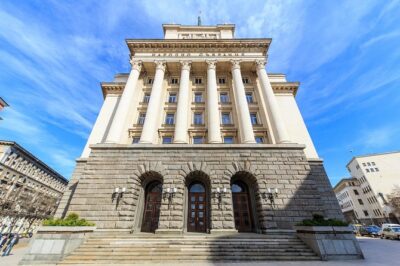
Sofia Highlights 2 Hour Sightseeing Walking Tour
Read our review →
Seven Rila Lakes Snowshoe Walk & Thermal Spring Pools
Read our review →Browse the lists this tour appears in