
Review · OLD TOWN WALKS
Full Day Eco Private Tour in Koprivshtitsa and Plovdiv
History comes alive in old houses. This private day trip links Koprivshtitsa, the mountain town tied to Bulgaria’s April Uprising, with Plovdiv’s Roman ruins and colorful Old Town. I like the mix of small-town traditions and major ancient sights, and I like that the journey uses hybrid or electric vehicles where available.
The private format gives your group a more personal day than a large coach tour. The guide can explain the woodwork, painted walls, and revolutionary stories as you walk. The main drawback is the pace: with roughly two hours to Koprivshtitsa, a one-hour lunch, a 1-hour-40-minute transfer to Plovdiv, and three hours in the city, you will need good walking shoes and realistic expectations.
In This Review
- Key points to know before booking
- Why this Sofia day trip works
- The road to Koprivshtitsa and its mountain setting
- Oslekov House and the first look at National Revival design
- Todor Kableshkov House and the story of revolt
- Lyutov House and traditional household craft
- Dimcho Debelyanov House and Bulgaria’s literary side
- Lunch before the road to Plovdiv
- Plovdiv’s Ethnographic Museum and the house with 170 windows
- The Ancient Theatre of Philippopolis
- Old Town streets, Roman remains, and the Kapana area
- Prince Alexander-I Street and the final city walk
- Is $208.37 per person good value?
- Who will enjoy this day most?
- Should you book it?
- FAQ
- Where does the tour start?
- What time does the tour begin?
- Where does the tour end?
- How long is the tour?
- Is transportation included?
- Is this a private tour?
- Is lunch included?
- What is included in the price?
Key points to know before booking
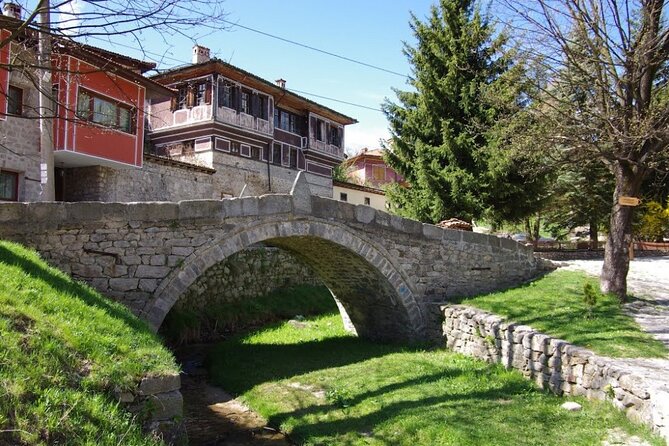
- Koprivshtitsa comes first: Walk cobblestone lanes and visit National Revival house museums tied to Bulgaria’s 19th-century culture and revolution.
- Five museums are planned: The named stops include Oslekov House, Todor Kableshkov House, Lyutov House, and Dimcho Debelyanov House, so confirm the fifth museum with your guide.
- Plovdiv packs in ancient and modern sights: The route includes the Ethnographic Museum, Ancient Theatre, Old Town, Roman landmarks, Kapana, and Prince Alexander-I Street.
- Private transport changes the day: Your group gets its own air-conditioned vehicle, onboard WiFi, and private transportation from central Sofia.
- The eco angle is useful, not just decorative: Hybrid and electric vehicles make the long road journey a lower-impact choice, though you should confirm which vehicle is assigned.
- The price works best for a group: At $208.37 per person, value depends heavily on group size and how much you value private transport and guiding.
Why this Sofia day trip works
Sofia is a good base for seeing more of Bulgaria, but the two destinations here offer very different experiences. Koprivshtitsa is compact, quiet, and closely linked to the struggle against Ottoman rule. Plovdiv is a larger city with Roman remains, 19th-century houses, cafes, shops, and a busy pedestrian center.
That contrast gives the tour its purpose. You are not spending 11 hours looking at one kind of monument. You begin with mountain scenery and local architecture, then move to an urban center layered with ancient, Ottoman-era, National Revival, and modern Bulgarian life.
The tour begins at 8:00 a.m. by the Patriarchal Cathedral St. Alexander Nevsky in central Sofia. It ends at the same meeting point. Pickup is offered, but the stated meeting point is the cathedral, so confirm the exact pickup arrangement before departure.
This is a private activity, meaning only your group participates. That matters on a full day. You can ask for extra explanation at a museum, move more quickly through a room that interests you less, or clarify the plan if the schedule starts to tighten.
More Old Town Walks in Sofia
- From Sofia: Plovdiv and Koprivshtitsa Full Day Tour
★ 4.7 · 314 reviews - Plovdiv and Koprivshtitsa Full-Day Trip
★ 4.5 · 177 reviews - From Sofia: The Rose Valley & Koprivshtitsa 12 hrs Day Tour
★ 4.7 · 39 reviews
The road to Koprivshtitsa and its mountain setting
The first drive takes about two hours. The route itself is part of the appeal, with mountain views and a gradual change from Sofia’s city streets to Koprivshtitsa’s traditional setting.
The tour description calls for a hybrid or electric vehicle, and the transport includes air conditioning and WiFi. One piece of feedback specifically praised the comfortable electric bus and the chance to enjoy the scenery while reducing the group’s carbon footprint. Since the exact vehicle can vary, I would confirm whether your departure uses a fully electric vehicle or a hybrid.
Koprivshtitsa is best approached as an open-air history lesson. Its cobblestone streets and preserved houses show how prosperous Bulgarian families lived during the National Revival period. The town is also tied to the April Uprising of 1876, a major revolt that helped shape Bulgaria’s road toward independence.
You will walk between the museums, so the surface underfoot matters. The route is not a simple vehicle-based sightseeing stop. Wear firm, comfortable shoes, and expect some uneven cobblestones and frequent pauses.
Oslekov House and the first look at National Revival design
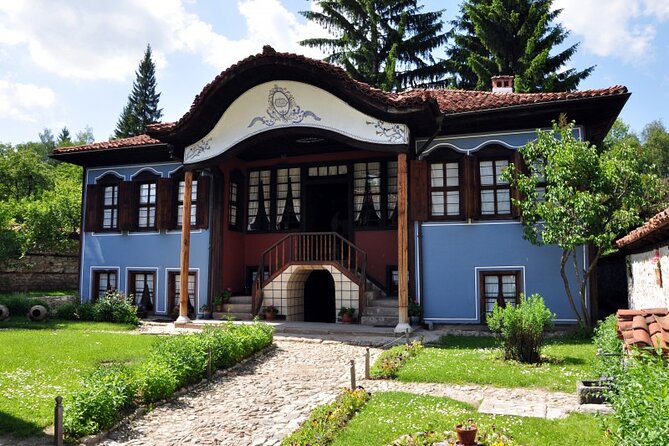
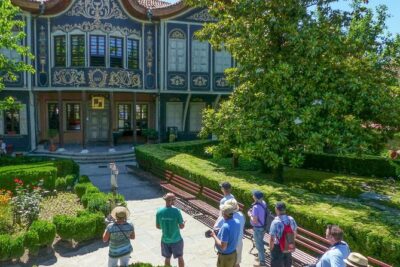
Oslekov House is the main opening stop in Koprivshtitsa. Its triple-arched entrance gives the building a memorable front, while the interior uses strong colors ranging from scarlet to sapphire blue.
The house belonged to a wealthy merchant who was executed during the 1876 April Uprising. Displays in Bulgarian, English, and French help explain both the building and its former owner. That language support is useful if you want to read at your own pace instead of relying only on spoken explanation.
Allow plenty of attention here. The house is not just a pretty photo stop. Its design, furnishings, and displays help explain the social position of wealthy merchants during the 19th century. You will get more from it if you look at how rooms were arranged and decorated, not only at the exterior.
The supplied timing gives this first museum a long visit, though the full Koprivshtitsa portion is also described as a roughly three-hour walking tour. The numbers do not line up perfectly, so ask the guide how much time is planned inside each house.
Todor Kableshkov House and the story of revolt
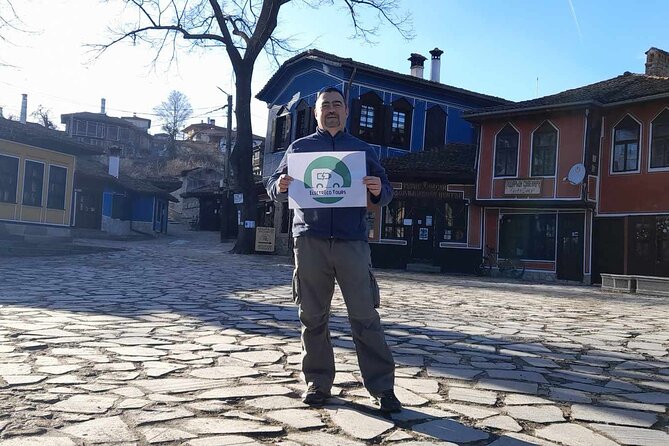
The Todor Kableshkov House Museum takes you to the birthplace of Todor Kableshkov, associated with the famous blood letter of the April Uprising. The house dates from 1845 and was built by master-builder Gencho Mladenov.
Its appeal is architectural as much as political. The design is symmetrical, and the upper-floor saloon has tall glazed windows. Look up at the carved ceilings, doors, and cupboards. These details show the high level of craftsmanship available to prosperous Bulgarian families at the time.
The planned stop is about 30 minutes. That is enough for a guided look, but not enough for a slow, room-by-room study. If the wood carving interests you, tell your guide early so you can use the available time well.
More Private Tours in Sofia
- Private city walking tour of Sofia
★ 5.0 · 141 reviews - Sofia Walking Private City Tour
★ 5.0 · 127 reviews - Private Day Trip to Boyana Church and Rila Monastery
★ 5.0 · 108 reviews - Private City Tour of Sofia
★ 4.5 · 34 reviews
Lyutov House and traditional household craft
Lyutov House was built in 1854 for Stefan Topalov, a wealthy citizen. Its painted walls and curved wood ceilings give it a different feel from the other houses, even though all belong to the same broad National Revival tradition.
The display of plasti, handmade colorful woolen covers, adds a useful household detail. These objects connect the grand architecture to everyday work and domestic life. They also give you something specific to look for beyond the standard sequence of portraits and period furniture.
This stop is scheduled for about 30 minutes. I would treat it as a focused visit rather than a leisurely museum hour. Let the guide point out the best examples, then take a few minutes to notice the patterns and colors for yourself.
Dimcho Debelyanov House and Bulgaria’s literary side
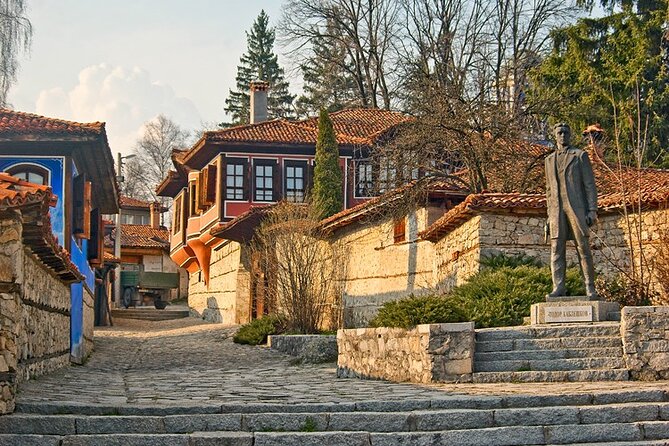
The Dimcho Debelyanov House shifts the story from revolution and merchant life to literature. The poet Dimcho Debelyanov once lived here, and the preserved National Revival building contains exhibits connected to his life and work.
This is a worthwhile change of subject. A visit to Koprivshtitsa can otherwise become a steady procession of revolutionary names and architectural details. The poet’s home shows that the town’s cultural importance was not limited to the 1876 uprising.
The itinerary says the walking tour visits five house museums, but the named stops provide details for four: Oslekov House, Todor Kableshkov House, Lyutov House, and Dimcho Debelyanov House. Ask which fifth house is included and how long you will spend there. That simple question will help you plan your time and avoid confusion.
Lunch before the road to Plovdiv
Lunch at a local restaurant is planned for about one hour, and it is not included in the tour price. This gives you a chance to try Bulgarian food rather than eating from a roadside stop, but you should budget separately for the meal.
An hour is practical, though not generous if the restaurant is busy. Keep your order simple if you want to stay on schedule. The tour has a 1-hour-40-minute transfer to Plovdiv afterward, so lunch is your main chance to pause before the second half.
The long transfer is the day’s biggest practical compromise. You are covering two distant destinations from Sofia, and road time takes a large share of the 11-hour schedule. The payoff is variety, but this is not the right choice if you prefer slow museum visits or long breaks.
Plovdiv’s Ethnographic Museum and the house with 170 windows
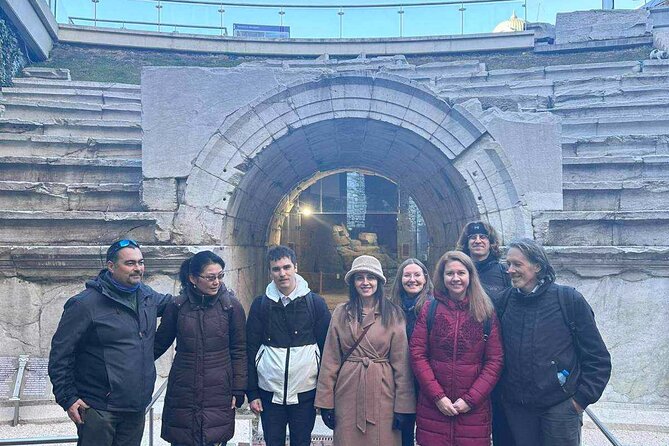
Plovdiv begins with the Ethnographic Museum, housed in a large National Revival building known as the house with 170 windows. It is described as the biggest Revival-period house in the Balkans.
Inside, displays cover Bulgarian clothing, textiles, traditional crafts, household customs, and ways of life. Woven rugs and folk costumes make the visit visually strong, while the building itself is part of the lesson.
The scheduled visit is about 30 minutes. That is enough for an introduction, but you cannot study every object in detail. Pay attention to the guide’s main themes, then use your remaining time for the exhibits that interest you most.
The museum also provides a bridge between Koprivshtitsa and Plovdiv. You have already seen how wealthy families lived in preserved homes. Here, you get a wider view of Bulgarian customs and material culture.
The Ancient Theatre of Philippopolis
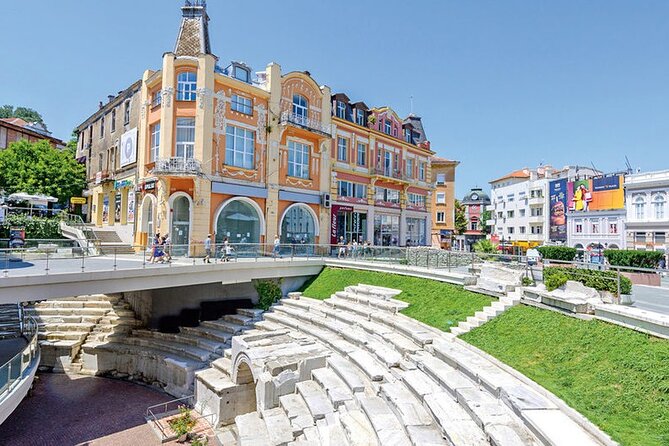
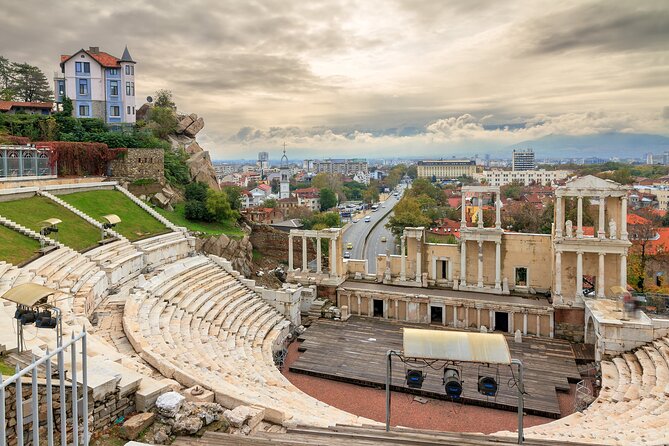
The Ancient Theatre is one of Plovdiv’s major sights. Built in the first century AD, it is remarkably well preserved and still used for performances.
Its semicircular seating and stone stage area make the Roman past easy to picture. This is not a ruin where you need a great deal of imagination. You can see how the structure worked, how the seats rise around the performance space, and why the setting remains useful today.
The visit lasts about 30 minutes. That should give you time for the main explanation and photographs. It is worth asking the guide about the theatre’s Roman name, Philippopolis, and how the site fits into Plovdiv’s long urban story.
The tour also mentions the Roman Stadium and Roman Small Theatre. These are encountered around the city rather than listed as separate admission stops. Your guide can point them out as you move through the pedestrian center.
Old Town streets, Roman remains, and the Kapana area
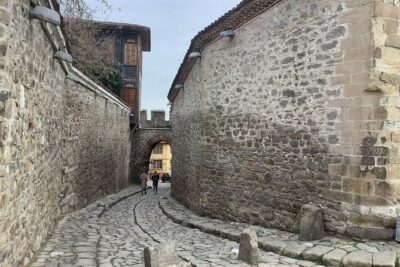
Plovdiv’s Old Town is where the day becomes less formal. After the museums and theatre, you walk through cobblestone lanes lined with colorful 19th-century houses, old walls, Roman remains, cafes, and small courtyards.
The route includes landmarks such as the Balabanov House, the Roman Stadium, the Roman Small Theatre, and the Roman forum. Some sights are viewed from outside or along the walking route, so do not expect a separate museum entry for every location.
Kapana, the city’s art neighborhood, adds a more modern note. The area is included in the wider walk, along with Plovdiv’s main pedestrian street, Prince Alexander-I Street.
The full Plovdiv section is listed at about three hours. That is enough for a useful introduction, especially with a private guide linking the sites together. It is not enough to explore every side street, shop, gallery, and cafe. If you want free time, ask whether part of the final period can be used without guiding.
Prince Alexander-I Street and the final city walk
Prince Alexander-I Street is Plovdiv’s main pedestrian thoroughfare. Cafes, boutiques, historic landmarks, street activity, and Roman remains line the route.
This is a good place to end because it lets you experience Plovdiv as a living city rather than only as an archaeological site. You can stroll, take photographs, and get a sense of how the old and new parts of town share the same center.
The schedule gives this area a substantial amount of time, though the itinerary also lists the Old Town and other Plovdiv stops within the three-hour city visit. The exact division will depend on your guide and the pace of your group.
Do not expect a long independent shopping period unless you arrange it. The tour is built around guided sightseeing, and the return to Sofia still has to fit within the 11-hour day.
Is $208.37 per person good value?
The listed price is $208.37 per person. That is a serious amount for a day trip, but the value depends on your group size and priorities.
You are paying for private transportation, an air-conditioned vehicle, WiFi onboard, museum admissions, and a guide for a very long day. You also avoid arranging separate transport to two destinations, comparing local connections, and managing the timing between Koprivshtitsa and Plovdiv.
The price makes the most sense if you are traveling with family or friends and want the convenience of a private vehicle. Group discounts may improve the calculation. For a solo visitor or a couple, the cost feels harder to justify unless private touring and the eco transport option are especially important to you.
Lunch is extra. Build that into your budget, and remember that the tour returns to Sofia rather than ending in Plovdiv.
Who will enjoy this day most?
I would choose this tour if you want to see two important Bulgarian destinations in one day and prefer a private guide to independent planning. It suits people who enjoy architecture, political history, traditional crafts, Roman sites, and steady walking.
It is also a strong choice for a small group that wants an alternative to a standard coach excursion. The private setup can make explanations easier to follow and gives you some control over the rhythm.
I would hesitate if you dislike long drives, need generous museum time, or want a relaxed Plovdiv evening. The schedule is ambitious. You will see a lot, but you will not experience either place at a slow pace.
The eco feature is a meaningful plus. One direct account praised the comfortable electric vehicle, the scenery, and the reduced carbon footprint. Still, confirm the vehicle type before booking if fully electric transport is central to your decision.
Should you book it?
Book this tour if your Sofia stay is short and you want a guided introduction to both Koprivshtitsa and Plovdiv without handling the transport yourself. The combination of National Revival houses, April Uprising history, folk culture, Roman architecture, and modern Plovdiv streets gives you a useful picture of Bulgaria in one demanding day.
Skip it if you want depth over range. In that case, spend a full day in Plovdiv or choose a slower visit to Koprivshtitsa. For everyone else, the private format, included admissions, eco-minded transport, and strong guide feedback make this a practical high-value option for a small group.
Free cancellation is available up to 24 hours before the 8:00 a.m. start time. Changes or cancellations inside that window are not accepted for a refund.
FAQ
Where does the tour start?
The stated meeting point is the Patriarchal Cathedral St. Alexander Nevsky in Sofia Center, at pl. Sveti Aleksandar Nevski, 1000 Sofia, Bulgaria.
What time does the tour begin?
The tour begins at 8:00 a.m.
Where does the tour end?
The activity ends back at the meeting point in Sofia.
How long is the tour?
The full experience lasts about 11 hours.
Is transportation included?
Yes. The tour includes private transportation in an air-conditioned vehicle, with WiFi onboard. The experience is promoted as using hybrid and electric vehicles.
Is this a private tour?
Yes. Only your group participates.
Is lunch included?
No. Lunch at a local restaurant is planned for about one hour but must be paid for separately.
What is included in the price?
The tour includes private transportation, an air-conditioned vehicle, onboard WiFi, and admission tickets for the listed museum and theatre visits.
Recently added around Sofia
- Veliko Tarnovo & Arbanasi Full day tour★ 5.0 · 5 reviews
- Private Winter Day Trip to the Rila Mountain★ 4.5 · 3 reviews
- Sofia Hidden Gems: Small-Group Walking Tour with Tram Ride★ 5.0 · 7 reviews
- Private transfer from Sofia to Plovdiv or vice versa★ 5.0 · 8 reviews
- Zemen Monastery, Boyana Church and National History Museum Tour★ 5.0 · 2 reviews
- Catacomb Tour in Sofia guided by a Local★ 4.5 · 3 reviews
- Tour to Koprivshtitsa and the Buzludzha monument incl the Seuthes Thracian Tomb★ 3.5 · 3 reviews
- From Sofia: The gorges of Trun and Dragovski stone trail★ 5.0 · 6 reviews
Old Town Walks, compared.

ATV and Buggy Off-Road Tour in Veliko Tarnovo and Arbanasi
Read our review →

Browse the lists this tour appears in